Play is Important for Parents' Mental Health
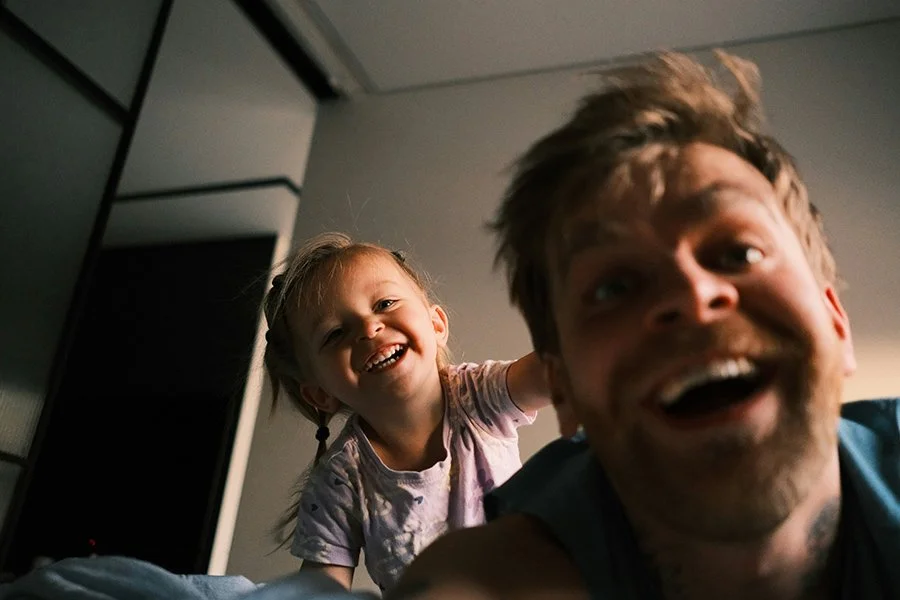
Photo by Vitalii Khodzinskyi
Too exhausted and overwhelmed to play with your kids? An Active for Life article explores the significance of playfulness in adult life for maintaining positive mental health as a parent, with explanations of the concept and suggestions for refreshing and recharging.
In the article, Brandi Heather explores how playing with her children helped her improve her own mental health. She talks about her journey through depression and how, “My experience has been that when mental health is strained, good things become harder to notice. Not because joy has disappeared, but because an overwhelmed nervous system shifts into protection mode. In that state, feelings of safety and playfulness are harder to access. And safety matters when it comes to play.”
She references research summaries on the National Institute for Play website that demonstrate “play is a state of mind that one has when absorbed in an activity that provides enjoyment and a suspension of sense of time…The characteristics of play all have to do with motivation and mental attitude, not with…the behaviour itself.” Physiologically, the play state begins in the midbrain. “When you encounter something playful, neurons in your midbrain light up. They start a cascade of connections that light up neurons across the brain and create a play state.”
The importance of play in children’s development is well documented. However, overwhelmed with the demands of family life, exhausted or struggling with their mental health, parents can easily feel that they do not have the energy to play with their children, or even to connect with playfulness for their own regeneration. They can feel that they have “forgotten how to play.”
The author talks about how, “through years of study and lived experience, I’ve come to understand and study this as our Playful Intelligence™—the human capacity to adapt, stay curious, and find creative ways forward when life feels uncertain. When I couldn’t access play for myself, I didn’t just lose my joy. I also lost access to this adaptability. Things felt heavier. I felt there were very few options. Even small changes felt harder to manage.”
Heather stresses that it is important to be clear that “play does not mean forced fun. In fact, if an activity isn’t voluntary, it isn’t play. Play looks different for everyone – what brings ease to one person may create anxiety for another.” She makes the following suggestions:
Play doesn’t start with activities. It starts with noticing: notice what’s already happening – in your body, in your environment, in small, unguarded moments such as;
Stepping outside and feeling fresh air on your face
That second when your breath deepens without effort
A song on the radio that brings a smile or a memory
Sunlight through a window
A quiet moment when your shoulders drop just a little
When the nervous system is overwhelmed, noticing can feel difficult. And yet, noticing is often what helps us find our way back – not because life suddenly changes, but because our system gets a moment of relief.
It’s not about pretending things are okay. It’s about paying attention to what brings even a hint of steadiness. Many parents have spent so long caring for others that they’ve lost touch with what helps them feel grounded.
Play that belongs to you doesn’t have to look like play with your children. It might show up through movement, music, quiet creativity, learning something new, time with animals, or walking in nature.
If play feels like pressure right now, that’s information not judgment. It says nothing about how much you love or care for your children. It may simply be an invitation to slow down and notice.
Play doesn’t disappear when life gets hard. It grows quiet. And when there’s space – even a little – it finds its way back.