“So Many Good Things Outside”
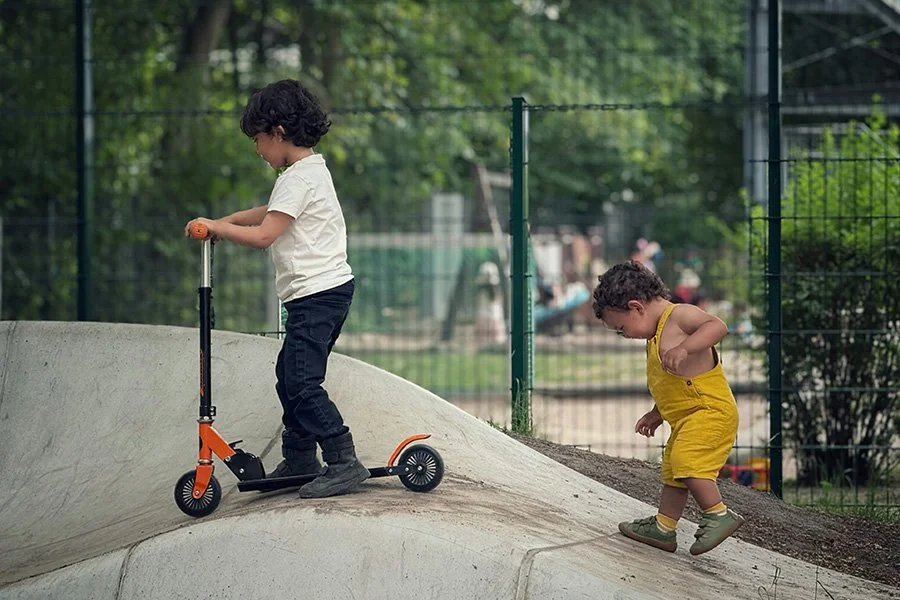
Photo by Nada Elmekkawi
Childcare Canada has posted a new research study on children’s perspectives of the value of outdoor learning experiences in ECE settings.
The study, ‘There are so many good things outside, let me tell you’. Children’s qualitative perspectives of outdoor play affordances at early learning and child care, by Ramsden et al., looked at children’s perspectives of outdoor play affordances at two ELCC centres in the Greater Vancouver Region of B.C. that are participating in the PROmoting Early Childhood Outside study. Twenty children aged 3–5 participated in observations, semi-structured interviews, child-led tours and map-making. Results from the analysis identified children’s affordances for play through four thematic categories: physical play, social play, imaginative play and nature play.
The findings:
· highlight the importance of actualized outdoor affordances that incorporate accessible sensory elements and encompass varied challenges
· further supports the integration of traditional and natural play features to maximize children’s diverse play experiences
· substantiates young children as capable research participants
· strengthens the application of affordance theory to children’s outdoor play.
The study notes that, while research has consistently demonstrated the value of outdoor play for children, “recent trends in children’s outdoor time and chosen activities demonstrate declines in outdoor play in comparison to previous generations. This decrease in children’s outdoor play can be attributed to the changing landscape of neighbourhoods, increased time spent on screens and structured activities, societal safety concerns and shifting family priorities.”
The study recognizes that early learning and child care (ELCC) centres can provide opportunities for outdoor play not otherwise experienced, however “these spaces may not always offer optimal settings to stimulate outdoor play”. Affordances, components of the physical environment, “invite children to participate in a given action or behaviour, and in reciprocity, environmental properties also influence the individual and shape environmental perceptions. Affordances will be viewed differently depending on the child, their preferences and capabilities, and how they view the physical environment on a given day….The consideration of affordances, as unique to each child, is important when considering how outdoor spaces at ELCC settings are designed.” The authors note that, “while ELCC centres must comply with applicable licensing requirements, they retain discretion in the design and utilization of their outdoor spaces, a feature broadly consistent across Canadian provinces and territories.”
While recent research has emphasized the importance of natural features, portable equipment and support structures that offer play affordances such as shade, many ELCC centres continue to rely on fabricated, fixed structures (e.g. dedicated open areas, climbing structures, sandboxes, gardening areas and structured tricycle tracks) that focus on providing gross motor play opportunities and do not consider other play experiences such as sensory and restorative play forms and risky play.
Current research focusing on realizing children’s rights emphasizes that “spaces and places must consider the youngest citizens through active and reciprocal planning and design tools. Capturing children’s perspectives using a participatory planning approach allows children to experience, learn, evaluate, act and improve their own environments and considers them as meaning makers and active participants in a wider decision-making process. Children’s preferences, shaped through interactions with their environment, reveal how affordances for play are realized in action.” The aim of this particular study was to explore children’s perspectives of outdoor affordances, focusing on preferences for play and actualized behaviour”.
Children’s voiced perspectives identified four types of play as important themes: physical play; social play, imaginative play; and nature play. Environmental features contributing to play affordances for children included:
· sandboxes
· tricycle paths
· gardening areas
· playhouses
· climbing structures
· water features
· stumps and logs
Findings:
· Children’s preferences for play were shaped by the opportunities their outdoor environments provided.
· Climbing structures, sandboxes, and gardening areas offered overlapping forms of play that simultaneously supported physical, social, imaginative, and nature-based experiences
· Environmental constraints, including weather and spatial configuration influenced use of space: rain reduced the usability of play features, and shaped children’s choices and engagement, while play features with ample circulation space encouraged dynamic, integrated interactions
· Children were naturally drawn to outdoor play features that supported multiple functions; e.g. climbing structures offered physical challenges alongside social interactions, while gardening areas enabled nature exploration in conjunction with imaginative play.
· Previous research has highlighted that open-ended and interconnected play spaces provide more affordances than environments dominated by fixed, pre-defined equipment and rigidly zoned areas with narrowly prescribed uses.
· Actualized affordances were also realized when fixed outdoor features (e.g. climbing structures, playhouses, raised planters) were located in close to sensory elements including sand, water and leaves. The proximity and accessibility of natural loose parts were critical to their integration with fixed structures; loose sensory elements rarely moved across large distances, creating restrictions on their use.
· Play features that presented a range of challenges supported children to engage in negotiation, imagination, social conversations, and peer observations. Out door affordances were preferred when they offered graded challenges so that children can gradually expand their confidence. Children also expressed preferences for graduated challenges that supported their decision-making processes. Providing varying levels of challenge, and different forms of challenge, supports children to select experiences that match their comfort levels and developmental needs.
· Consistent with prior research, the current study highlighted how heightened challenges, such as uneven and unpredictable surfaces, varying terrain, diverse heights, and inclusion of slopes, support actualized affordances for play.