Making Storytime Immersive
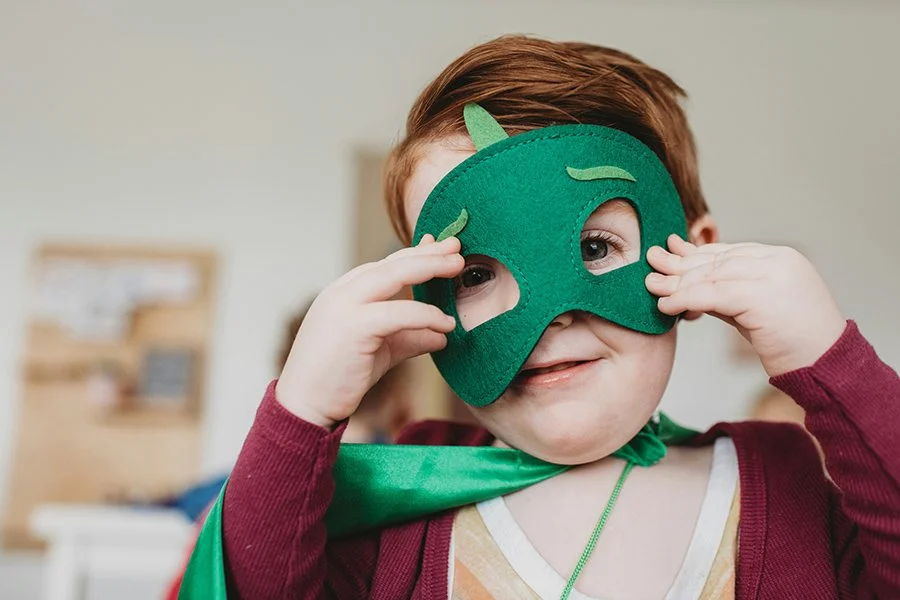
Photo by Jessica Rockowitz
An edutopia article by Kendall Stallings, “Take Your Read-Alouds From Interactive to Immersive” demonstrates how adding costumes and sound effects can increase children’s engagement in story time.
The article explains how reading stories to children helps them build vocabulary, language fluency, and comprehension. Many teachers also use interactive strategies, such as asking children to identify character traits or make predictions based on context clues and inferences, to improve critical thinking. The author explains how, in preparing questions for a reading of Julia Donalson’s The Gruffalo, “a rhyming, whimsical tale of a fictional creature named the gruffalo, who encounters several animals in the woods and threatens to eat them, only to be outsmarted by a tiny mouse”, she was struck by how the story lent itself to a theater exercise. Given that the story is too advanced for most kindergarten children to read independently, she decided to try having the children participate actively in the story while the teacher did the reading.
She had the children create woodland drawings, which were displayed around the classroom, then listed off the book’s characters and worked with the children to allocate characters. She then provided simple costumes and props for the characters and arranged the children around the room.
She writes, “As I got into the story, I traveled around the classroom, stopping to ask and answer questions while encouraging students to act out the preceding page in front of their woodland backdrops. By the end of the book, students were fully engrossed – they had a new appreciation for the setting and characters’ feeling. For instance, the child playing the gruffalo loved being able to shout fiercely and talk about why the gruffalo got scared. Other students imagined classroom furniture as trees to hide behind. One girl excitedly asked when we could do this activity again and act out another story.”
The immersive format allowed students who struggle with oral comprehension and receptive language skills to follow the story more easily – it gave them more participation options: visual, tactile and kinaesthetic. Also, those who have challenges with attention and sensory processing liked the immersive format, because it allowed them to move around and engage.
The author offers the following suggestions for immersive storytelling:
Costumes: These don’t have to be fancy – they might use simple accessories or identifiers such as sentence strip headbands with pictures of characters on them, or they can be more elaborate and include an actual dress-up component.
Props: Prop versions of objects from the story help those objects come to life, and you can pretend that classroom items are the objects themselves (e.g. trees in the forest). Creating drawings for backdrops, and use of realistic items to create a sense of being in the imagined space (e.g. small tree branches to create a sense of being in the forest).
Setting: Rearranging the furniture in the room can help to create a sense of the imagined space, as well as using backdrops/props to create ambiance. If the story takes place at night, turning down/off lights and using a lamp can be effective.
Sound Effects: To enhance the experience, it can be helpful to play background music or to utilize specific sound effects. “For The Gruffalo, I found a photo of a forest that I projected on our interactive whiteboard while playing suspenseful music, which created a captivating environment.”